The Structure of the Democratic Party of Torrance County
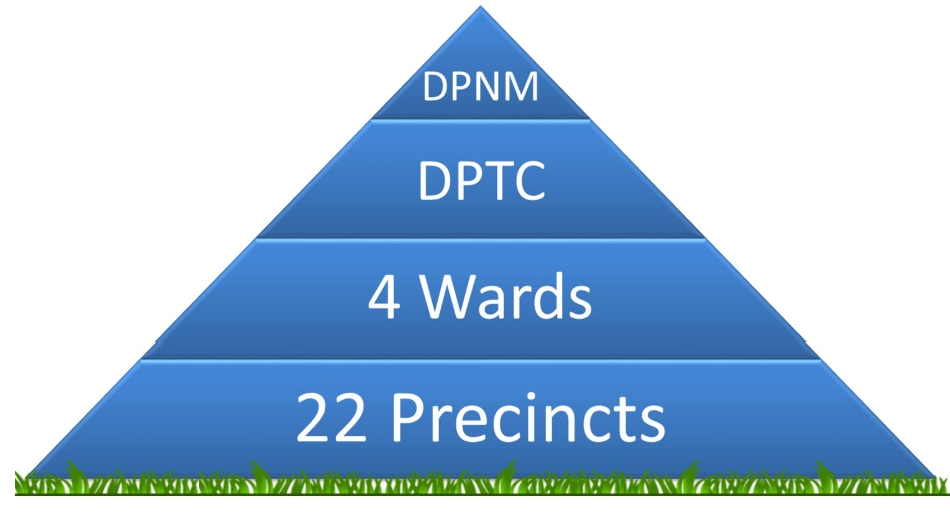 As the graphic on the left indicates, the structure of the Democratic Party in the state of New Mexico, and specifically in Torrance County, indicates, the party has a sort of pyramid structure, with the state party up top and the individual Democrats at the "grassroots" level at the bottom. While some might think that this is a "top down" structure, quite the OPPOSITE is true. Unlike some other political organizations, we're a "bottoms up" party. Here's the difference:
If we were a "top down" party like some, the Democratic Party of New Mexico's (DPNM) leadership would choose the chairperson of the county party. Then the county chair would select the officers of our four wards, and those appointed ward chairs would select the precinct chairs, who would then select their officers. But in our party it works in exactly the opposite fashion.
Every two years, in the spring of odd-numbered years, the incumbent state chair issues a call for county meetings to elect officers. The incumbent county chair then issues a call for ward and precinct meetings to elect local officers. At the meeting, the four incumbent ward chairs conduct elections for new ward chairs and ward officers. Then, participants in the four wards break off into precinct meetings for the 22 individual precincts where precinct officers and, in some cases, additional County Central Committee (CCC) members, are elected. The newly elected members of the CCC elect the county chair and county vice chair who will serve for the next two years, including representing Torrance County on the State Central Committee (SCC). The SCC is the supreme governing body of the DPNM, and elects the state chair and other DPNM officers.
So, now let's look at the roles of each of these officers within the county party, starting at the bottom and working up. To summarize, and expand to include positions not specifically mentioned already, here are the positions that you might choose to volunteer to fill: Precinct Chair; Precinct Vice Chair; Additional CCC Member; Ward Chair; Ward Vice Chair; County Chair; County Vice Chair; County Secretary and County Treasurer, and of course, there is always a need for additional volunteers!
The Precinct Chair: The late President Harry S. Truman is quoted as saying that "The most important job I ever had was Precinct Captain". Some states still call the position “Precinct Captain” but here in New Mexico the same position is called “Precinct Chair”. Whatever you want to call it, the Precinct Chair position is still the most important job in the Democratic Party, because all of the good that a volunteer can do for the party starts at that grassroots level.
Torrance County has 22 precincts, and thus the party needs 22 Precinct Chairs. The position typically only requires about two hours a week of volunteer effort. Basically, there are only three duties of the Precinct Chair, but those three duties are the lifeblood of the party. The Precinct Chair serves as a member of the County Central Committee, is in charge of voter involvement at the local level and serves as a conduit for information going up and down between the party and voters within the precinct.
One of the least time-consuming, yet most important, duties of the Precinct Chair is that he or she serves as a member of the County Central Committee. The CCC is the supreme governing body of the party at the county level. It typically meets only once in a two-year period, in the spring of odd-numbered years, when its primary task is to elect the County Chair and County Vice Chair.
On rare occasions a special meeting may also be called by the County Chair to place a candidate on the ballot where the candidate selected through the Primary Election process withdraws or dies between the Primary and General Elections, but those situations are extremely rare.
That’s it! A couple of hours every two years, but they are extremely important hours!
The Precinct Chair is the one person that every Democrat who isn’t actively involved in the party structure should know personally. An active Precinct Chair makes an effort to get to know his or her neighbors by organizing local events to encourage engagement. A monthly get-together with neighbors, like picnics, holiday parties or even just a casual coffee klatch goes a long way towards encouraging people to get involved, possibly even to volunteer to assist the Precinct Chair within their own neighborhood.
And then, during election years, the Precinct Chair is the key organizer of the “GOTV” (Get Out the Vote) effort, encouraging their local Democrats to vote and assisting those who need help with rides or absentee ballots. The Precinct Chair is basically the face of the Democratic Party within their own precinct. As part of their role interfacing with the public, it’s important that Precinct Chairs become certified as Voter Registration Agents, to assist voters in getting registered to vote and updating their registrations when changing their addresses or party affiliation.
Going hand-in-hand with the Precinct Chair’s role of interfacing with the Democrats in their precinct, the Precinct Chair also serves as a conduit for information flowing both ways. It’s obviously important that information needs to flow down from the state party and the county party leadership, but it’s equally important that information flows back up. The Precinct Chair is the most important link in the information chain going both ways. If there’s something special happening at the state or county level, it’s the Precinct Chair’s job to see to it that the voters know about it.
But, perhaps even more importantly, the Precinct Chair is the way that voters can provide feedback to the county party and higher. If the Precinct Chair knows of a family or individual in need somewhere in their precinct, they can let their Ward Chair know about it, as well as organizing assistance themselves, and get support from the higher levels of the party to assist neighbors in need.
Back to the List
The Precinct Vice Chair: Not every precinct is fortunate enough to have a second person who is willing and able to shoulder the responsibilities of managing a precinct, but those precincts who have such a second individual are wise to elect them to the optional position of Precinct Vice Chair. Unlike the Precinct Chair position, the Vice Chair position has no specific duties. Instead a Vice chair assumes whatever portion of the Precinct Chair's duties as the two of them agree on. By rule, if the Precinct Chair resigns, dies or moves out of the precinct, the Precinct Vice Chair, if there is one, automatically becomes the Precinct Chair for the remainder of the two-year term. The Precinct Vice Chair is NOT automatically a member of the CCC!
Back to the List
"Additional" County Central Committee Members: Every two years, during the winter before the odd-numbered year elections discussed above, a process called “apportionment” is conducted by the party’s officers. It’s a strictly mathematical process, utilizing the votes in each precinct for the Democratic candidates for Governor and President in the last two general elections. The formula rewards precincts with relatively high voter turnout with additional County Central Committee members, granting at least one CCC member, in addition to the Precinct Chair, to a minimum of 2/3 of the precincts.
In 2025 seven of our 22 precincts could only have one person representing them on our CCC . . . the Precinct Chair. Seven other precincts could have had a second CCC member. Four precincts could have had two additional members and four could have had three additional members for a total of four. Altogether, including the incumbent County Chair, County Vice Chair and the four Ward Chairs, that’s potentially a County Central Committee of 55 members, with roughly half of the members being these “additional” CCC members who have a very simple role. All that’s required of them is to show up for the biennial CCC meeting to elect the County Chair and County Vice Chair, and very rarely to conduct some other business.
That’s all! Normally just a few hours, once every two years. Of course, participation in other party activities is allowed and even encouraged. In many cases additional CCC members will serve as Precinct Vice Chairs and/or event volunteers, but technically all that’s required of them by party rules is that one meeting in the spring of odd-numbered years.
Back to the List
The Ward Chair: As mentioned above, the party conducts elections biennially in the spring of odd-numbered years to elect officers, precinct chairs and additional members of the CCC. In between the Precinct Chairs and the county party officers there is an additional layer of organization at what is known as the ward level. Unlike precincts, which are designated by the County Clerk’s office and are officially recognized as separate entities throughout all levels of government, wards are strictly a party construct. They are a cluster of precincts, grouped together geographically and, when possible, demographically.
Torrance County has four wards . . . three with five precincts each and one with seven precincts. Each ward includes somewhere between 650 and 900 registered Democrats. When our elections are held biennially the first elections in the sequence are the elections of Ward Chairs and Ward Vice Chairs, even before Precinct Chairs and additional CCC members are elected.
While the Precinct Chair is generally considered to be the most important position in the party, since it’s the level that deals most directly with the grassroots voters, the importance of the Ward Chair should not be underrated. The Ward Chair’s role is similar to that of the Precinct Chair’s, but on a somewhat higher level. Like the Precinct Chair, the Ward Chair is an automatic member of the County Central Committee, with equal voting rights within that body. Additionally, the Ward Chair is a member of the county party’s Executive Committee and the Rules Committee.
Like the Precinct Chair, the Ward Chair often needs to interface directly with the voters at the grassroots level, although if there is an active Precinct Chair within the precinct that’s primarily the job of the Precinct Chair. However, if there is no Precinct Chair, or the elected Precinct Chair vacates the position for any reason, it’s the responsibility of the Ward Chair to appoint a new Chair for the precinct. This means that the Ward Chair should do everything they can to get to personally know as many of the Democrats in their ward as possible. To this end, just as precinct chairs are encouraged to organize social events in their precinct, ward chairs are encouraged to do the same on a larger scale. There’s no better way to get to know your Democrat neighbors than through local community get-togethers!
Like the Precinct Chair, the Ward Chair should be a Voter Registration Agent, and be prepared to register voters at any time.
In addition to community involvement and the bidirectional communication aspects of the Ward Chair’s responsibilities, a Ward Chair serves as a member of the county party’s Executive Committee. Consisting of all the Ward Chairs and the four county officers, the Executive Committee is largely an advisory body with no specific authority aside from specific duties that the County Chair might designate or that the County Central Committee might place on it. Although the party Rules don’t mandate any particular frequency for its meetings, quarterly meetings are usually considered to be a minimum.
The Ward Chair is also usually the ward’s representative on the County Rules Committee. That committee is charged with developing and/or modifying the County Rules to be approved by the County Central Committee. The Rules Committee also serves as a judicial body to settle internal disciplinary issues. It’s not required that the Ward Chair serve on the Rules Committee. They may choose to defer that position to another member of the ward, but if the ward does not choose to elect a different representative at the biennial meeting to elect ward and precinct officers, the Ward Chair becomes the ward’s representative by default.
Back to the List
The Ward Vice Chair: Like the position of Precinct Vice Chair, the Ward Vice Chair Position is optional, but it's highly recommended that wards elect a Vice Chair to assist the Ward Chair and to provide an automatic succession for the Ward Chair position should that position become vacant for any reason. Also like the Precinct Vice Chair, the Ward Vice Chair is NOT automatically a member of the CCC, although in many cases the Ward Vice Chair is also one of the ward's Precinct Chairs or Additional CCC Member, in which case they WOULD BE a CCC member.
Back to the List
The County Chair: The County Chair is the Chief Executive Officer of the county party, and as such is ultimately responsible for the party’s day-to-day activities. All minor decisions that need to be made pretty much on the fly are made by the County Chair. The Chairperson also normally presides at meetings of the County Central Committee and the Executive Committee, unless the County Chair appoints a different presiding officer. The County Chair is empowered to create and appoint whatever ad hoc committees he or she deems necessary, and appoints the chairperson of the two Standing Committees, those being the Rules Committee and the Resolutions Committee, as well as appointing replacement Ward and Precinct Chairs if there is no Ward or Precinct Vice Chair.
Back to the List
The County Vice Chair: Always a gender other than that of the County Chair’s, the County Vice Chair’s duties are whatever the County Chair designates. The Vice Chair temporarily assumes the duties of the County Chair if the County Chair is absent from the county, or if the County Chair resigns or dies, until a new County Chair is elected. The County Chair and County Vice Chair are the county party’s two automatic representatives on the State Central Committee, and as such are also automatic delegates to both the County and State nominating conventions, as well as being members of the County Central Committee and Executive Committee.
Back to the List
The County Secretary and Treasurer: All of the positions that we’ve discussed up to this point are elected positions, filled during the ward, precinct and county elections that are held in the spring of odd-numbered years. The positions of Treasurer and Secretary are different. They are appointed by the County Chair as soon as possible after the elections and serve at the pleasure of the County Chair.
The County Secretary’s primary responsibilities are to record and preserve the minutes of meetings of the County Central Committee and Executive Committee. Although not automatically a County Central Committee member, the Secretary is an automatic member of the Executive Committee. The Secretary also files required non-financial reports with the state party and County Clerk. They also lead the team that arranges those meetings and does just about anything else the County Chair delegates to them.
The County Treasurer is the Chief Financial Officer of the party, submitting Treasurer’s Reports to the County Central Committee, delegates to the biennial County Convention and to the Secretary of State’s office. Like the County Secretary, the Treasurer is an automatic member of the Executive Committee, but not an automatic member of the County Central Committee.
Back to the List
Other Volunteers: In addition to all the official positions we’ve discussed up to this point, there are several other ways that volunteers can help the county party. As mentioned in the segment about the County Chair, the Chairperson is empowered to create any committees that they deem to be advantageous to the administration of the party and has the power to appoint members and chairpersons to those temporary committees. There can be committees for parades and floats, event booths, management of the office, fundraising, Information Technology work and just about anything else that the County Chair desires, in order to help advance the goals of the party, including helping staff the party's office.
And, of course, for those individuals who, for any reason, cannot physically be involved in the party’s work, there is always the option of donating money, equipment, materials or “in kind” donations of specialized labor.
Obviously, there is much work to be done and, as the expression goes, “Many hands make light work.” If you possess a skill that you think the party could put to good use, contact your Precinct Chair, Ward Chair or the County Chair and get involved!